The Site of Pain Is Rarely the Site of the Problem: What a Primary Lesion Is
A disc herniation at L5/S1 — but the actual cause sits at Th12/L1. What a primary lesion is, how it is located, and why the Rayess-Schöning Technique treats that site instead of the site of pain.
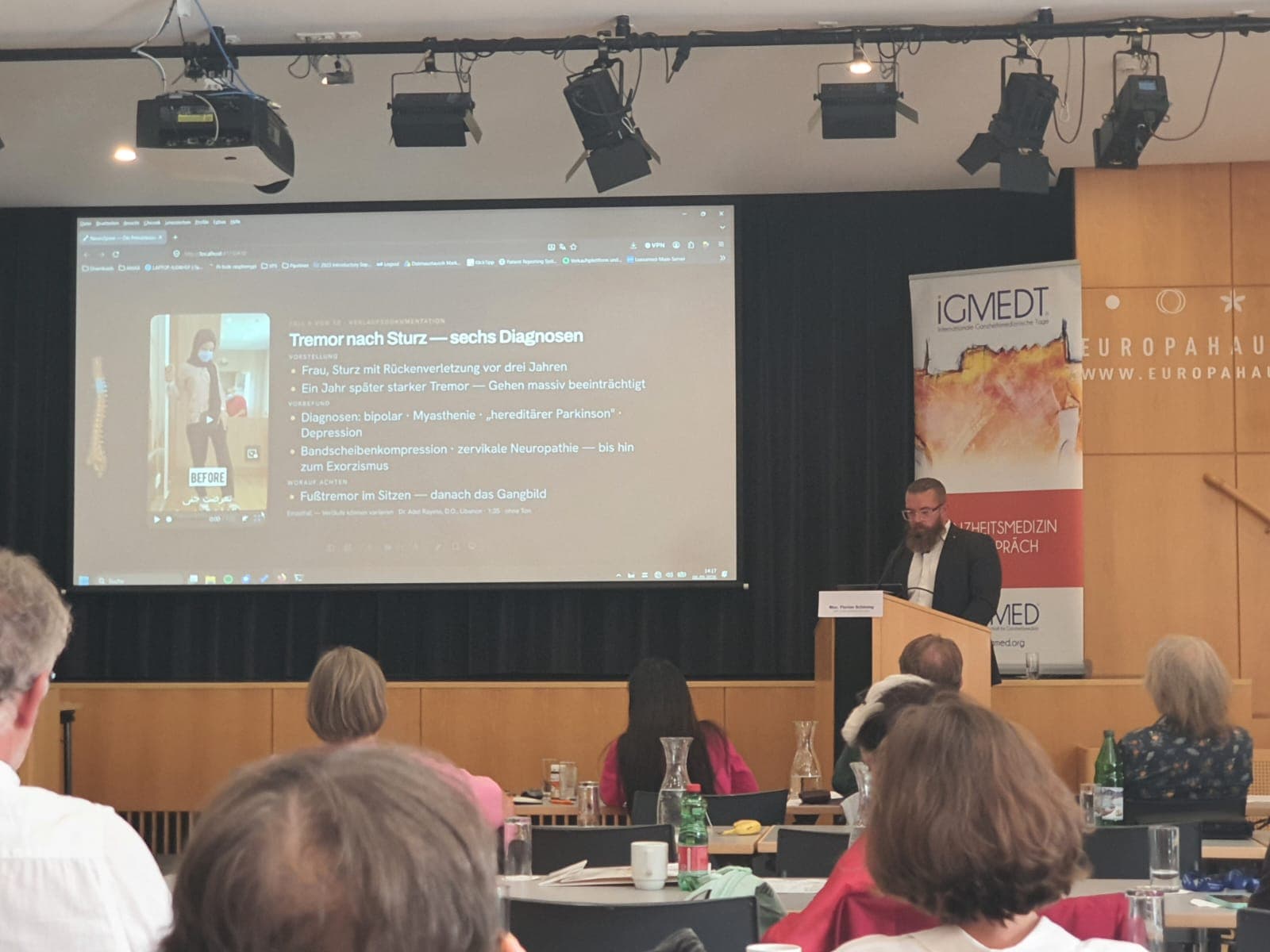
On September 6, 2026, Florian Schöning took the stage at the IGMEDT Congress in the Europahaus Vienna — in the day's final slot, its time already halved by the talks before him. No room for theory, only for what matters in daily practice: the search for the primary lesion.

Official congress poster for IGMEDT 2026, Europahaus Wien (source: iggmed.org).
What a Primary Lesion Is
Most diagnostic attention goes to the place where the patient feels pain, or to the spot where an MRI shows a finding. Primary lesion diagnostics reverses that order: it first asks where along the spine the one site sits that irritates the entire system — regardless of where the pain shows up or what the image happens to highlight.
„Angenommen, es ist ein Bandscheibenvorfall L5/S1 und die primäre Läsion ist Th12/L1 – dann behandeln Sie Th12/L1. Fertig." (quote in the original German)
The disc herniation stays exactly where it is. It is not treated, because according to this diagnostic approach it is not the site that is sustaining the system.
How the Method Came About
The technique originates with Dr. Adel Rayess, an osteopath (D.O.) from Lebanon who has been examining the primary lesion site for 28 years. He did not discover it on a patient, but on the dissection table: during his osteopathic training, he was responsible for preparing cadavers for anatomy classes with a scalpel.
„Und dabei ist ihm aufgefallen, dass, so lange er an der Wirbelsäule entlangfährt, es immer eine Stelle gibt, wo das Skalpell nicht flüssig durchläuft, sondern wo er richtig arbeiten musste." (quote in the original German) That spot sat at a different level in every body. The question of whether this one fixed spot also exists in a living patient became the starting point of a method Dr. Rayess has spent three decades refining ever since.
Find One Site, Treat One Site
Florian Schöning summed up the underlying principle in Vienna in a single sentence: „Das Entscheidende an der Methode ist, die eine Stelle zu finden, die eine Stelle zu behandeln und alles in Ruhe zu lassen." (quote in the original German)
That is what sets the Rayess-Schöning Technique apart from an approach that follows the symptom map and treats several segments at once. Instead, it starts with a single diagnostic question: where is the primary lesion — not: where does it hurt.
Spinal adjustment itself also plays a role here: it is one of the strongest manual inputs into the nervous system, because its effect on the system is especially direct. What matters is not the force of the technique, but that it is applied exactly at the previously located primary lesion site — not just anywhere along the spine.
Two Ways to Locate the Primary Lesion
In Vienna, Florian Schöning presented two approaches that are taught side by side in the seminar:
- Palpation. Anyone experienced in working with their hands can palpate the primary lesion site — Dr. Rayess himself always examines and treats manually, in that order.
- MRI interpretation. Anyone without hands-on experience reads the MRI differently: not looking for the most striking finding, but for the site that is irritating the system. Dr. Rayess has developed his system to the point where the primary lesion can be located from the image alone.
A third approach — the Nervoscope as an instrument-based addition — is the subject of its own, not yet written, article.
Honesty Instead of Promises of Success
Asked whether every primary lesion can be found and treated equally fast, Florian Schöning answered candidly in Vienna: „Wenn das so wäre, dann wäre ich Tremor-Spezialist und würde hier nicht stehen und reden, dann wäre ich irgendwo am Strand." (quote in the original German) There are cases where the primary lesion can be identified quickly, and cases that clearly demand far more experience.
Important context for this article: the case examples shown in the talk and in the seminar are individual case documentation from the practice of Dr. Rayess and Florian Schöning. They demonstrate a diagnostic approach, not a guarantee of success — individual courses differ, and not every primary lesion responds equally fast.
Why This Matters for a Trained Audience
For physicians, Heilpraktiker, and osteopaths who have already seen an MRI showing a disc herniation a hundred times over, primary lesion diagnostics shifts the question: not "how do I treat this finding," but "is this finding actually the cause." In chronic or repeatedly pre-operated cases, this exact shift is often the point where previously obvious treatment approaches had already proven ineffective.
The injection technique used to additionally treat a located primary lesion — 5% dextrose, perineural, not prolotherapy — is the subject of its own article.
How to Learn It
Locating the primary lesion — by hand or by image — is a skill that can be trained, not a talent you have to be born with. In the NeuroSPINE Seminar Level 1, Dr. Adel Rayess and Florian Schöning teach exactly that: primary lesion diagnostics and, in the second part, the NeuroNJect injection technique used to treat the located site.
NeuroSPINE Seminar Level 1 · September 25–27, 2026 · Europahaus Vienna · with Dr. Adel Rayess and Florian Schöning · 3 days, 70% hands-on practice, 20 seats.
Florian Schöning — Heilpraktiker (German licensed alternative practitioner) and physiotherapist (M.Sc.), co-founder of NeuroSPINE and developer of the NeuroNJect injection technique. 20 years of clinical experience · 120+ continuing-education courses · NeuroNJect/neuromodulation.
More about Florian Schöning →- NeuroSPINE at the IGMEDT Congress 2026: Looking Back on 26 Minutes at Europahaus WienLast slot of the day, speaking time cut in half, an audience two congress days deep in theory: how Florian Schöning presented NeuroSPINE at the International Holistic Medicine Days – and which question came up most often afterwards.
- Über eine Million Follower: Dr. Adel Rayess erhält den YouTube Gold Play ButtonDer YouTube-Kanal von Dr. Adel Rayess hat die Marke von einer Million Abonnentinnen und Abonnenten überschritten – YouTube würdigt das mit dem Gold Play Button.
- Dr. Adel Rayess für die Digital Creator Awards 2026 nominiertDr. Adel Rayess ist in der Kategorie "Health" für die Digital Creator Awards 2026 nominiert – eine Publikumsabstimmung für arabischsprachige Content-Creator.