NeuroSPINE at the IGMEDT Congress 2026: Looking Back on 26 Minutes at Europahaus Wien
Last slot of the day, speaking time cut in half, an audience two congress days deep in theory: how Florian Schöning presented NeuroSPINE at the International Holistic Medicine Days – and which question came up most often afterwards.
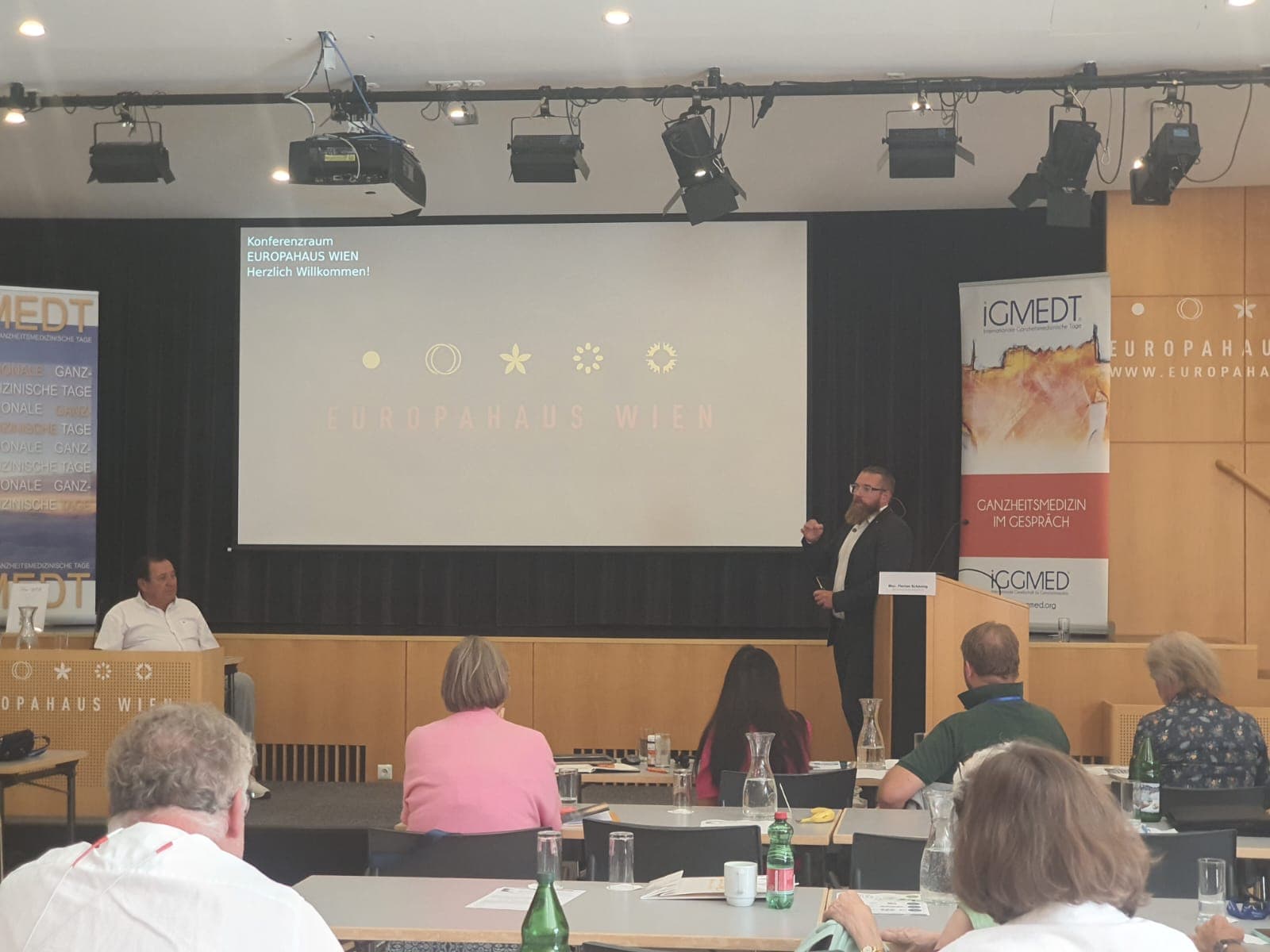
From 4 to 6 September 2026, Europahaus Wien hosted the International Holistic Medicine Days (IGMEDT), organised by the International Society for Holistic Medicine (IGGMED), this year under the motto “Holistic Medicine in Conversation”. On Saturday afternoon, in the congress’s final lecture slot, Florian Schöning presented NeuroSPINE – the combination of Dr. Adel Rayess’s primary lesion technique with the NeuroNJect injection technique.
A Slot Half as Long as Planned
Fifty minutes had been scheduled. Because the preceding talks had run over, twenty-six remained. The decision was made at the lectern: no more theory for an audience that had been listening to theory for two days, but practice – case documentations, a few key sentences, and the rest via the QR code on the last slide.
What Fit into 26 Minutes
The talk followed the logic of the method itself: diagnostics first, then treatment.
- Dr. Adel Rayess’s technique. How the osteopath from Lebanon came across the primary lesion at the dissection table during his training and has done nothing else for roughly three decades than locate this one spot – told through case documentations from his practice, including spine patients with multiple previous surgeries.
- NeuroNJect. The perineural injection with five-percent glucose that Florian Schöning has further developed – deliberately set apart: “It is not prolotherapy. It has a completely different purpose, it works completely differently … it is 5 % glucose.” (Translated from the German original.)
- Three ways to the primary lesion. Palpation for those who work with their hands; MRI interpretation for those who don’t; the Nervoscope as an instrument-based indicator.
- The treatment. One targeted manipulation at exactly one spot – and, for anyone who does not want to or should not manipulate, alternatives such as shockwave. Tools many in the room already had in their kit.
The guiding sentence that holds it all together came in the first half: “The decisive thing about the method is to find the one spot, to treat the one spot, and to leave everything else alone.” (Translated from the German original.)
The Question That Came Up Most Often Afterwards
It was not the case documentations that prompted most of the follow-up questions, but a concern: can this be learned at all if you have never worked manually? The answer was already in the talk:
“If you say now, I am not a hands-on therapist … Dr. Rayess has perfected his system to the point where he can also see on the MRI image where this primary lesion site is.” (Translated from the German original.)
The method has two entrances – the hand and the image. Those who can palpate feel for the primary lesion. Those who never learned to do so learn to read the MRI differently: not looking at the finding everyone sees, but at the spot that irritates the system. What a primary lesion is, and why the site of pain is rarely the site of the problem, is explained in detail in the article “The Site of Pain Is Rarely the Site of the Problem”.
Honesty Among Professionals
A congress audience of physicians and therapists listens closely when case videos are shown. That is why the same applied in the room as here on the blog: the courses shown are individual case documentations from the practices of Dr. Rayess and Florian Schöning. They demonstrate a diagnostic approach, not a rule. Asked whether it goes like this for every patient, the talk gave a clear answer: no – but there are options for some patients where one would otherwise struggle in vain.
Thanks
Thanks to IGGMED for the invitation and the closing slot, to the Europahaus team for technology and patience – and to the previous speaker, who had already mentioned five-percent glucose before NeuroNJect was even up.
What Comes Next
Three weeks after the congress, Dr. Adel Rayess and Florian Schöning return to the very same hall: NeuroSPINE Seminar Level 1, 25–27 September 2026, Europahaus Wien – three days, 70 % hands-on, a maximum of 20 participants. There, what could only be touched on in 26 minutes will be shown in full: finding the primary lesion by hand and on MRI, the manipulation at one spot, the NeuroNJect technique.
This article reports on a continuing-education event for professionals and reflects the teaching and experience of the presenters as delivered there. The case courses mentioned are individual case documentations; they are no assurance of a particular treatment outcome and do not replace individual medical advice.
Florian Schöning — Heilpraktiker (German licensed alternative practitioner) and physiotherapist (M.Sc.), co-founder of NeuroSPINE and developer of the NeuroNJect injection technique. 20 years of clinical experience · 120+ continuing-education courses · NeuroNJect/neuromodulation.
More about Florian Schöning →- Über eine Million Follower: Dr. Adel Rayess erhält den YouTube Gold Play ButtonDer YouTube-Kanal von Dr. Adel Rayess hat die Marke von einer Million Abonnentinnen und Abonnenten überschritten – YouTube würdigt das mit dem Gold Play Button.
- Dr. Adel Rayess für die Digital Creator Awards 2026 nominiertDr. Adel Rayess ist in der Kategorie "Health" für die Digital Creator Awards 2026 nominiert – eine Publikumsabstimmung für arabischsprachige Content-Creator.
- Finding the Cause Before Treating It: A Look Back at the First NeuroSPINE SeminarThree days, one question: where does a complaint actually begin? A look back at the first NeuroSPINE seminar in Vienna – and the diagnostic mindset behind it.