Finding the Cause Before Treating It: A Look Back at the First NeuroSPINE Seminar
Three days, one question: where does a complaint actually begin? A look back at the first NeuroSPINE seminar in Vienna – and the diagnostic mindset behind it.
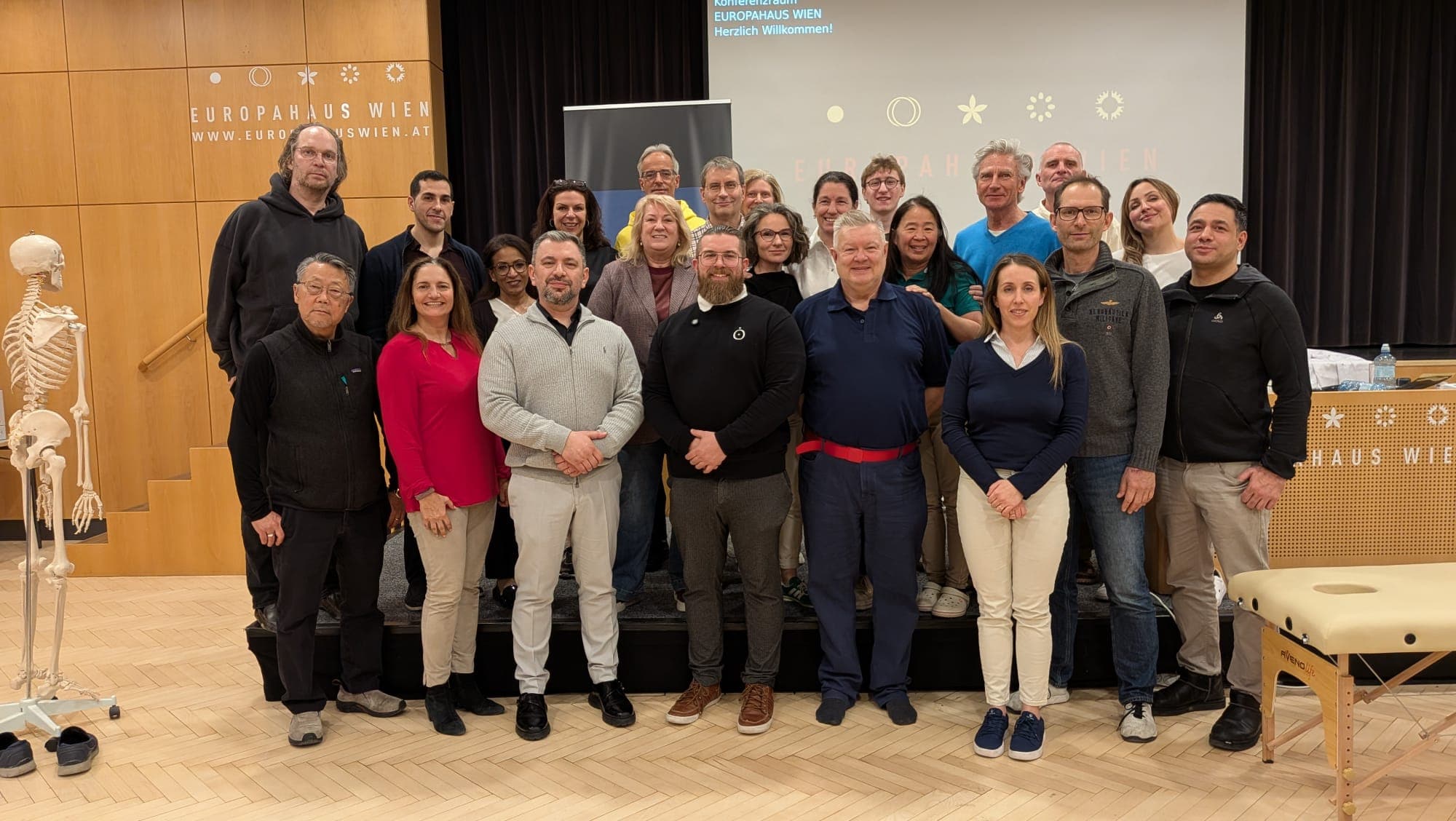
In late February 2026, therapists gathered in Vienna to spend three days working through a single fundamental question: how do you tell the place that hurts apart from the place where the problem actually originates? It was the first NeuroSPINE seminar of its kind – led by Dr. Adel Rayess (D.O.) and Florian Schöning.
Primary Lesion, Not Symptom Site
The seminar's throughline was the concept of the primary lesion: the structure in the body that forms the actual starting point of a faulty load pattern – often far from the place where pain later shows up. Analyzing X-rays together, Dr. Rayess explained the principle like this:
"Primary lesion is the structure that has the least damage here. Where you see the most damage is always the secondary lesion, never the primary lesion."
In other words: the site with the most visible damage is usually the body's compensation – not the cause. The actual lesion often shows up exactly where the least wear is visible.
Feeling, Not Just Measuring
A large part of the three days was devoted to hands-on palpation – the targeted, gentle manual examination of joints and ligaments. Participants practiced on volunteers, learning to detect restrictions in the sacroiliac joint, the upper cervical joints, and the spine that imaging alone does not reveal. Dr. Rayess described the difference this way:
"The ligaments are very white here and here it's yellowish. This is how you know. No life in the area."
The idea behind it: healthy connective tissue reacts and moves; blocked tissue loses that responsiveness – a finding you can feel by hand but not read off an MRI.
A Body Always Compensates
The theory sessions covered the biomechanical compensation principle: when one joint is blocked on one side, the body often compensates crosswise elsewhere – for example, a blockage at the first cervical vertebra on the left leading to a counter-movement at the second cervical vertebra on the right. This principle was the reason so much of the seminar was spent distinguishing cause from compensation before treatment was even discussed.
Three Levels, One View of the Person
The seminar's holistic framing came from dividing the work into three levels: biomechanical (manipulation and mobilization), biochemical (including the NeuroNJect injection technique presented in the seminar, using a 5% dextrose solution), and bioelectric (neuromodulation). The point of this division, in the speakers' view, is that a single method alone rarely captures the whole picture.
At the close of the seminar, Dr. Rayess summed up his underlying stance:
"Life is movement. That's why when you die, you stop moving. So we are giving life again to specific joints."
And, looking at his own biography and that of many colleagues in the room:
"Every person has a primary lesion. No one is born extremely happy in his life. Everyone had shocks – physical, emotional, and they are here."
The cases and techniques discussed in the seminar serve professional continuing education and reflect the experience and teaching views of the speakers. They do not replace individual diagnostics and are not a guarantee of any particular treatment outcome in an individual case.
Florian Schöning — Heilpraktiker (German licensed alternative practitioner) and physiotherapist (M.Sc.), co-founder of NeuroSPINE and developer of the NeuroNJect injection technique. 20 years of clinical experience · 120+ continuing-education courses · NeuroNJect/neuromodulation.
More about Florian Schöning →- NeuroSPINE at the IGMEDT Congress 2026: Looking Back on 26 Minutes at Europahaus WienLast slot of the day, speaking time cut in half, an audience two congress days deep in theory: how Florian Schöning presented NeuroSPINE at the International Holistic Medicine Days – and which question came up most often afterwards.
- Über eine Million Follower: Dr. Adel Rayess erhält den YouTube Gold Play ButtonDer YouTube-Kanal von Dr. Adel Rayess hat die Marke von einer Million Abonnentinnen und Abonnenten überschritten – YouTube würdigt das mit dem Gold Play Button.
- Dr. Adel Rayess für die Digital Creator Awards 2026 nominiertDr. Adel Rayess ist in der Kategorie "Health" für die Digital Creator Awards 2026 nominiert – eine Publikumsabstimmung für arabischsprachige Content-Creator.