Precision, Not Chance: What the Second NeuroSPINE Seminar Taught About Perineural Injection Technique
How do you find with your hands something no X-ray and no MRI shows? At the second NeuroSPINE seminar, fine palpation and precise injection technique took center stage.
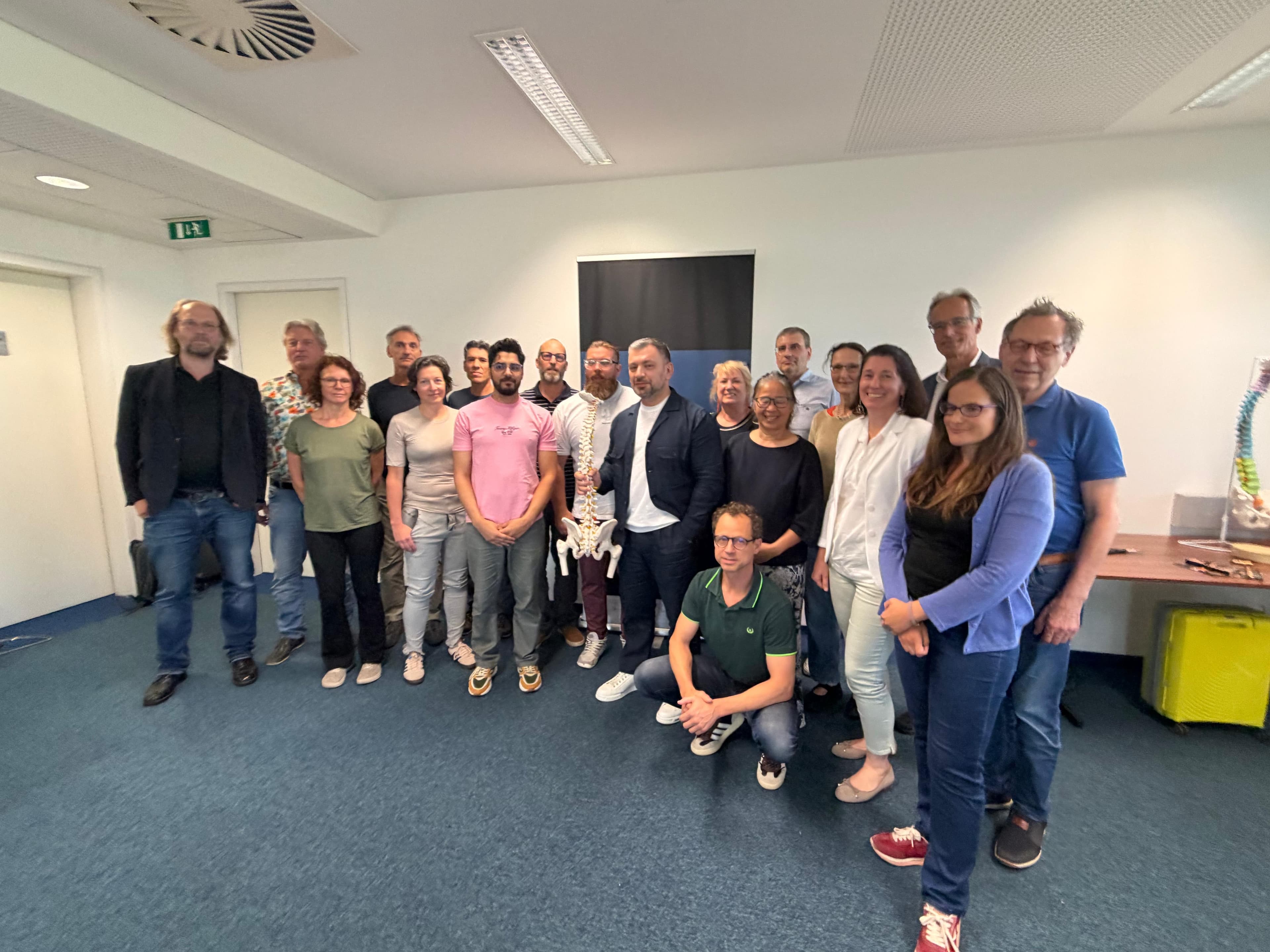
In May 2026, the second NeuroSPINE seminar took place. This time the focus was less on the theory of the primary lesion itself – already familiar from the first round – and more on its practical application: how do you palpate precisely enough to find the right spot, and how do you place an injection there with precision?
The Jumping Sign as a Guide
One central diagnostic tool Dr. Adel Rayess introduced is the so-called jumping sign: a gentle, repeated pressure test at specific nerve points that triggers a characteristic response when there is genuine irritation.
"Jumping sign is give a gentle push, but the outcome is the jumping sign, you don't need to push hard."
What matters here is explicitly not force, but the precision of hand positioning – a point Dr. Rayess emphasized repeatedly:
"You just need to practice a little bit your sensation of the hands."
Why the Hand Often Sees More Than the Machine
A recurring theme was the limits of imaging. According to Dr. Rayess, some fascial and connective-tissue structures simply cannot be visualized with today's technology:
"This fascia or ligament cannot be seen on an X-ray, cannot be seen on an MRI. You need a 30-Tesla MRI to see this, which will come in the next 15 or 20 years."
This limitation is the actual reason so much of the seminar was spent training tactile sensitivity, rather than relying solely on diagnostic devices.
From Diagnosis to Injection
The practical portion covered the perineural injection technique using a low-concentration dextrose solution (5%) – placed superficially, but at anatomically precisely mapped points, including along specific spinal nerves and major nerve plexuses. Dr. Rayess described the required precision with a comparison from an entirely different field:
"It's like micro surgery."
Aftercare was also a topic: in his experience, the effect does not set in immediately, which is why he recommends keeping patients under observation for longer after treatment rather than ending the session abruptly.
A Philosophy, Not a Business Model
Also notable was a statement about his own treatment philosophy that Dr. Rayess made at the start of the seminar – in answer to the question of how he defines a successful treatment:
"My only purpose is to get rid of him."
This is explicitly not a rejection of patients, but the stated goal of making them independent again quickly through the most effective treatment possible – rather than keeping them coming back for repeat appointments.
This article, too, reflects the teaching views and experience conveyed at the seminar. It describes a continuing-education event for professionals and is not a guarantee of any particular treatment outcome for individual patients.
Florian Schöning — Heilpraktiker (German licensed alternative practitioner) and physiotherapist (M.Sc.), co-founder of NeuroSPINE and developer of the NeuroNJect injection technique. 20 years of clinical experience · 120+ continuing-education courses · NeuroNJect/neuromodulation.
More about Florian Schöning →- NeuroSPINE at the IGMEDT Congress 2026: Looking Back on 26 Minutes at Europahaus WienLast slot of the day, speaking time cut in half, an audience two congress days deep in theory: how Florian Schöning presented NeuroSPINE at the International Holistic Medicine Days – and which question came up most often afterwards.
- Über eine Million Follower: Dr. Adel Rayess erhält den YouTube Gold Play ButtonDer YouTube-Kanal von Dr. Adel Rayess hat die Marke von einer Million Abonnentinnen und Abonnenten überschritten – YouTube würdigt das mit dem Gold Play Button.
- Dr. Adel Rayess für die Digital Creator Awards 2026 nominiertDr. Adel Rayess ist in der Kategorie "Health" für die Digital Creator Awards 2026 nominiert – eine Publikumsabstimmung für arabischsprachige Content-Creator.